Most engineers use a coding agent.Few can build one.Be one of the few who can.Launch your AI engineering career.
A 13-week program for engineers who already ship code. You get a 1:1 roadmap call in your first week, build eight production AI systems that demonstrate current, in-demand AI engineering skills like agentic RAG, multi-agent systems and evals, and work with a placement team on job outreach, applications and interviews.
Students and graduates, in their own words. Three software engineers with zero prior AI engineering experience completed newline's AI Accelerator, and now they're building production-grade AI systems.
Hear from a senior platform engineer at Meta, a DevOps engineer, and a 15-year senior software engineer.
“
One of the most transformative things that I've done.
...It's very structured and in-depth, and whenever you have some questions there are always folks available to answer them...
Sachin Panemangalore
Senior engineer · Meta
“
Now I know how to make it do what I want it to do.
Before the program I was using AI with just prompts and as an elaborate search engine...
...I'm still just scratching the surface...
Ray Pollard
Software developer · DevOps
“
The information here goes beyond any other program.
I had no AI experience, Machine Learning, anything like that...
I've got a partial sponsorship from my employer to build a project that could save our company millions of dollars...
Jeff O'Connell
Senior engineer · insurance
// student outcomes
Where students landed. Four engineers, from where they started to where they are now.
Two were hired onto GenAI teams at Capital One and L'Oréal. Two were promoted to AI lead at the companies they already worked for. Pick one to see how they got there.
Anup V.Cohort 1
Backend engineer→toGenAI engineer
Background
Backend software engineer, between jobs.
Gap
Strong engineering foundation, no production AI experience, stuck in the tutorial learning cycle.
Program
Completed all eight production builds.
Outcome
Hired onto the Generative AI team at Capital One.
DJCohort 1
Senior software engineer→toAI lead
// his team today
DJ · AI lead
Engineer
Engineer
Engineer
Background
Software engineer, employed, seeking an AI title and a compensation increase without changing companies.
Gap
No production AI systems in his portfolio, and no internal AI project scoped or approved.
Program
Identified an internal use case, built a production AI system with technical guidance and prepared the promotion case, all while working full time.
Outcome
Promoted to AI lead, managing a team of three engineers, at the same company.
Ruby J.Cohort 1
Principal engineer→toAI lead
Background
Principal engineer, trajectory had plateaued.
Gap
Senior engineering credibility, no AI-specific production work.
Program
Built an AI pipeline for her HR team that scored thousands of resumes against hundreds of thousands of job descriptions.
Outcome
Promoted into a new AI lead role her company created for her.
Weekly live lectures, group coaching and Q&A sessions
Dedicated job placement team
// what it is
The AI Engineering Accelerator is a 13‑week live program, a portfolio of eight reviewed AI builds, and a placement team, all built around one job.
Getting you hired or promoted into an AI engineering role.
1
2
3
4
5
6
7
8
9
10
11
12
13
until your offer
FIG.1 · STACK MAP
curriculum 65 h
65 h
Week 1
Map your path
A 1:1 roadmap call with Zao and Dipen. You map your current stack against the AI roles you want, and the 60 to 70 hour curriculum gets cut down to the 20 to 30 hours you actually need.
FIG.2
build
evals
failures
review
building #1 · Doc Q&A retrieval pipeline0/8
Weeks 2 to 8
Ship eight builds
Eight production systems, including retrieval pipelines, a fine-tuned model and multi-agent applications. Each carries evaluations and a failure analysis, and a senior engineer reviews it before it goes into your portfolio.
FIG.3 · OUTREACH
resume ·linkedin ·site ·
0 applied → 0 replied → 0 interviews → 0 offers
Weeks 9 to 13
Get placed
The placement team rebuilds your resume, LinkedIn and portfolio site, contacts hiring managers, applies to openings for you, and coaches you through interviews and the offer.
What you get
Seven parts, each doing its share of getting you into an AI engineering role. Pick one to see it up close. Most are real screens from the course platform, live coaching, a student's build and the cohort community.
Your week-one roadmap
1:1 roadmap call
Zao Yang and Dr. Dipen Bhuva
Example background
You bringDomain track1 of 20You target
Backend engineer
Experience
7 years at a payments company
Stack
JavaPythonPostgres
General
FinTech
Legal
Healthcare and BioTech
Coding agents
Multimodal
Text-to-SQL
Music
Voice
E-commerce
Video
Autonomous agents
Cybersecurity
Browser agents
Drug discovery
Document AI
Energy and climate
AdTech
InsurTech
EdTech
AI FinTech Engineer
Your Unit 7 build
Build Your Own Financial Language Model
Domain builds
Fraud Detection Explainer
Transaction Summarizer
Trading Signal Generator
Your Evidence Pack
Outreach specialist
Contacts hiring managers and recruiters
Placement manager
Owns your search plan, checks in weekly
AI job search agent
Applies to active AI openings every week
Success manager
Schedule, blockers and accountability
Three internal interviews, then real ones
Your week-one roadmap
1:1 roadmap call
Zao Yang and Dr. Dipen Bhuva
Example background
You bringDomain track1 of 20You target
Backend engineer
Experience
7 years at a payments company
Stack
JavaPythonPostgres
General
FinTech
Legal
Healthcare and BioTech
Coding agents
Multimodal
Text-to-SQL
Music
Voice
E-commerce
Video
Autonomous agents
Cybersecurity
Browser agents
Drug discovery
Document AI
Energy and climate
AdTech
InsurTech
EdTech
AI FinTech Engineer
Your Unit 7 build
Build Your Own Financial Language Model
Domain builds
Fraud Detection Explainer
Transaction Summarizer
Trading Signal Generator
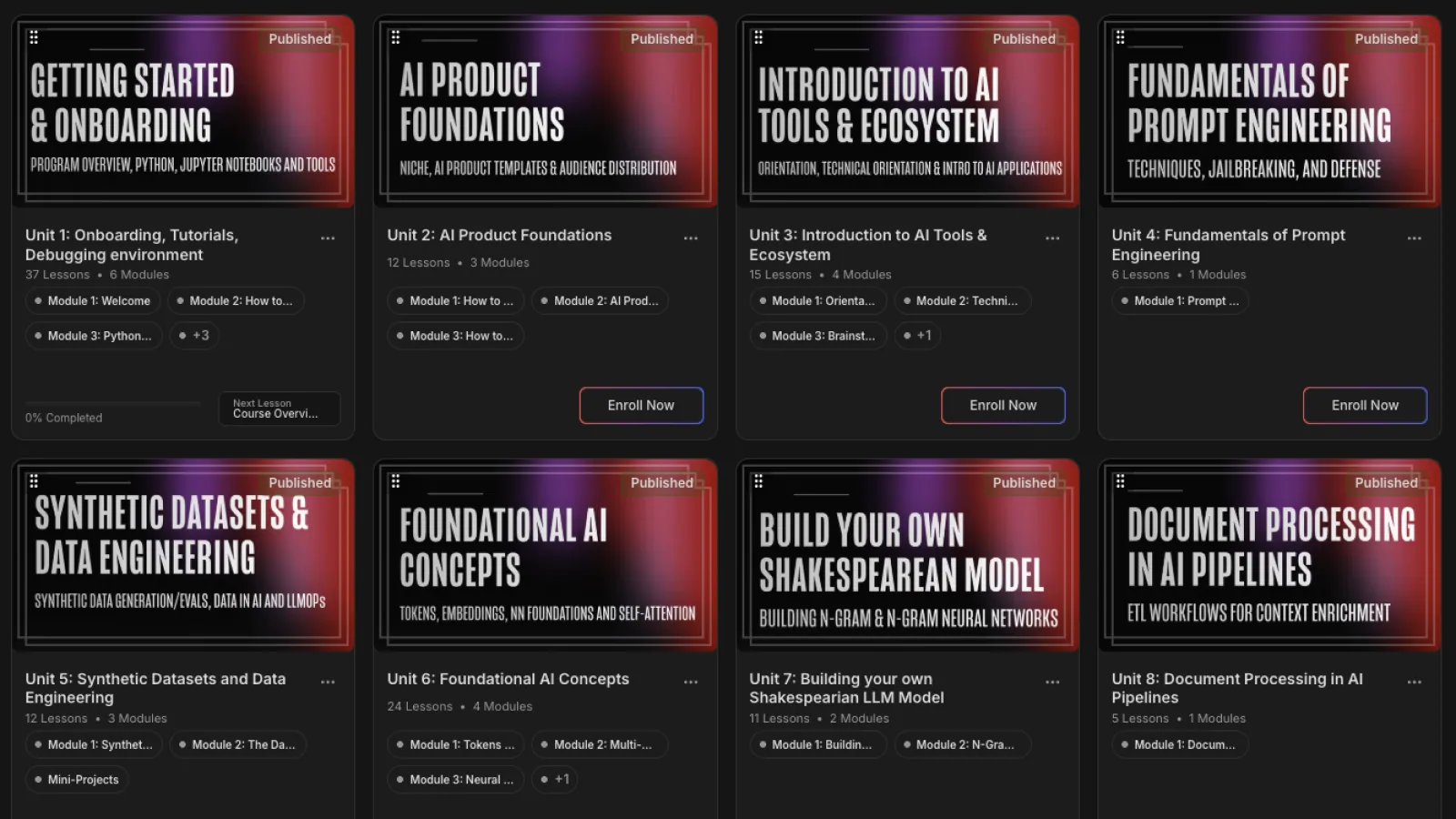
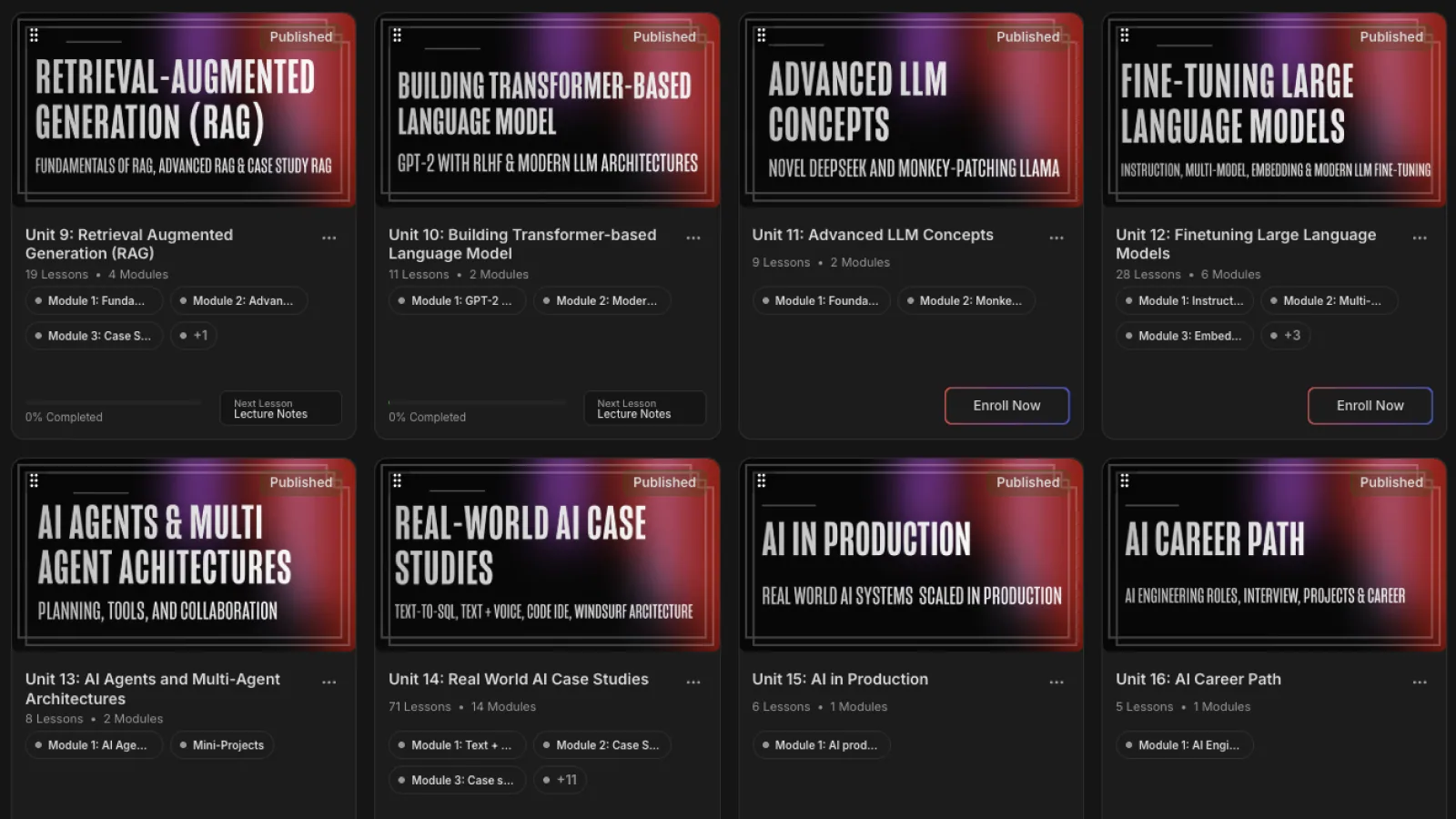
Course platform: units 1 to 16
A build notebook with its evaluation
Live coaching call
Job Trucker AI, a student build by Julia
Your placement team
Your Evidence Pack
Outreach specialist
Contacts hiring managers and recruiters
Placement manager
Owns your search plan, checks in weekly
AI job search agent
Applies to active AI openings every week
Success manager
Schedule, blockers and accountability
Three internal interviews, then real ones
Cohort community
before
“
Before joining the AI accelerator, you feel everything could be an API call to the GPT API or Gemini API, and everything feels rosy.
what changed
“
Going from a project to a product, that's the transformation the AI accelerator helped me identify.
Sachin Panemangalore
Senior engineer · Meta
before
“
There was no way to know if I'm making progress after changing something in the prompt, because I have no evals at all.
what changed
“
They were very emphatic: you need to create your own evals that will keep you north and give you direction whether you are making progress or not.
Kevin Martell
Engineer with an ML master's
before
“
I was looking to learn more about AI that wasn't just piecing together random things from the internet. I wanted a more structured approach.
what changed
“
What I'm already doing now is just building. I want to build some projects and some products with this knowledge.
James Newman
Tech lead · meal-kit company
before
“
I was barely keeping up with some research papers before.
what changed
“
Now I feel like I can understand even the things that are popping up every day, even reading the model cards, and lose the fear of trying any model or any technique.
Gonzalo Arreche
Co-founder · CTO · OK2Charge
// why now
AI engineering postings grew 40% in a year. Frontend engineering postings fell 10%.
Using AI tools at work and building the systems behind them are different skills. The postings and salaries below are for the second one.
FIG.1
13 weeks of AI tools · 0 systems built
01
Where most engineers are
Daily users of AI tools
You use Cursor or Claude Code every day. You have finished courses, wired up an API key, maybe shipped a feature. Then an interviewer asks how you would evaluate retrieval quality on a legal corpus, and you do not have an answer. You know what RAG and fine-tuning are, but you have not combined them in a system and measured it.
FIG.2 · JOB POSTINGS
2024 · every role at the same level
02
What changed
AI postings up, frontend down
From 2024 to 2025, ML and AI engineering postings grew about 40%, frontend postings fell about 10%, and backend grew about 4% (Bloomberry). LinkedIn counts roughly 1.6 million open AI roles against 500,000 qualified people.
FIG.3 · VERTICAL AI ROLE
yours ·+ ai ·
a vertical AI role, part by part0/9
03
What is possible now
Applied roles need your experience
Vertical AI roles need someone who can ship production software and add AI to it. You already do the first part. DJ and Ruby, above, moved from senior and principal engineer into AI lead roles at their own companies.
// in the words of engineers who called us this year
“
I'm overqualified and underqualified at the same time.
“
How do I get past the filter of three years deploying ML models in production?
“
I have been on Udemy for a year and have nothing to show for it.
“
Everyone on my team is talking about AI. I nod along.
“
I can see myself easily becoming deprecated over time.
“
I wouldn't call myself an AI engineer. I'm more of an AI consumer at this point.
“
You sign up for an AI newsletter. Every day there is something coming to the mailbox and you feel like this is going so fast. I don't understand half of what they're saying.
Bachir Babale
Ex-Xbox · #1 App Store apps
“
If you ignore AI and how it can boost your productivity as a software developer, you'll get left behind.
There are two kinds of AI engineer. Research roles need a PhD. Applied roles need a software engineer.
Builds
Horizontal (research)
The models: GPT, Claude, Gemini
Vertical (applied)
Products and systems on top of the models
Who hires
Horizontal (research)
OpenAI, Google DeepMind, Anthropic, Meta FAIR
Vertical (applied)
Any company building AI into its product or operations
Requires
Horizontal (research)
PhD, advanced math, publications
Vertical (applied)
Strong software engineering plus AI skills
Typical comp
Horizontal (research)
$400K to $2M+
Vertical (applied)
$140K to $300K+
Open roles
Horizontal (research)
About 5,000 globally
Vertical (applied)
About 1.6M now (LinkedIn, 2026), projected 4.2M by 2030
newline trains
Horizontal (research)
No
Vertical (applied)
Yes
Horizontal (research)
Vertical (applied)
Builds
The models: GPT, Claude, Gemini
Products and systems on top of the models
Who hires
OpenAI, Google DeepMind, Anthropic, Meta FAIR
Any company building AI into its product or operations
Requires
PhD, advanced math, publications
Strong software engineering plus AI skills
Typical comp
$400K to $2M+
$140K to $300K+
Open roles
About 5,000 globally
About 1.6M now (LinkedIn, 2026), projected 4.2M by 2030
newline trains
No
Yes
// what a vertical AI engineer does
For example, a law firm hires an AI engineer. That engineer takes 20 years of past case files, wins, losses and settlements, and builds a system that analyzes incoming cases and recommends whether to accept them, instead of junior lawyers spending 40 hours per case. The system connects to the firm's email, billing and CRM. The job needs your software engineering background plus the retrieval, fine-tuning and evaluation skills the program teaches. It does not need a PhD.
“
I am not going to go with a PhD to get that job. It's not my interest.
Anup
Full-stack and data engineer
“
It was more about high-level things, how LLMs work behind the scenes, but nothing related to the real job industry.
Kevin Martell
Engineer with an ML master's
// what you ship
What you ship, phase by phase Weeks 1 to 8 build your portfolio. Weeks 9 to 13 put it in front of employers.
You finish with the Evidence Pack: your reviewed builds, an open-source PR, two blog posts, and a rebuilt resume and portfolio.
13 weeks · 8 to 10 hrs a week · Live weekly, all recorded
You have a 1:1 roadmap call with Zao and Dipen in your first week. Together you map your current stack against the AI roles you want, pick a domain track, and cut the 60 to 70 hour curriculum down to the 20 to 30 hours you need. Then you work through the foundation units: AI product foundations, AI tools, and prompt engineering.
Onboarding and environmentAI product foundationsAI tools and ecosystemPrompt engineering
// you walk away with
A week-by-week roadmap aimed at named roles and comp ranges, a working dev environment, and a list of builds matched to what postings for those roles ask for.
"Zao pushed me into starting the project, and he said the homeworks are really designed as a template from which you can copy and paste code to begin doing your project."
Both tracks share the 16-unit core curriculum. The Consultant Accelerator adds Bootcamp 2: three advanced units and 25 lessons on state-of-the-art RAG, evals and RLHF.
AI Engineering Accelerator
13 weeks
16 units · 9 portfolio projects · 13 case studies
taught with
pick your domain track
AI EngineerThe core curriculum as is · 6 domain builds · 5 open-source targets
unit 01
Onboarding, Tutorials, Debugging
Python, Jupyter, the AI tools ecosystem
unit 02
AI Product Foundations
Finding your niche, growing an audience
unit 03
Intro to AI Tools & Ecosystem
First transformer LLM app, end to end
unit 04
Fundamentals of Prompt Engineering
Few-shot, chain-of-thought, jailbreaking and defense
unit 05
Synthetic Datasets & Data Engineering
Generation, evaluation, LLMOps · Mini Projects 1 & 2
unit 06
Foundational AI Concepts
Tokens, embeddings, self-attention, transformers
unit 07
Build Your Own Shakespearean LLM
N-gram LLM, N-gram neural net
unit 08
Document Processing in AI Pipelines
Parsing, extraction, ingestion
unit 09
Retrieval Augmented Generation (RAG)
Fundamentals, advanced RAG, a case study · Mini Projects 3 & 4
unit 10
Transformer-based Language Models
GPT-2 with RLHF, built from scratch
unit 11
Advanced LLM Concepts
DeepSeek architecture, MoE, monkey-patching Llama
unit 12
Finetuning LLMs
Instruction, multimodal, embedding FT · DPO / RLHF / PPO / GRPO · Mini Project 5
unit 13
AI Agents & Multi-Agent Architectures
Agent patterns, when multi-agent earns its cost · Mini Projects 6 & 7
Judging, debugging and gating agent systems at scale
LLM-as-judge pipelines at scale
Agent failure matrices and heatmaps
BERTopic clustering to find weak spots
Automated quality gates on every build
bootcamp 2 · unit 0315 lessons
Reinforcement Learning & RLHF
Foundations, frameworks, then RLHF in a production stack
MDPs, Q-learning and policy gradients
GRPO, RLVR and rubric-based rewards
DSPy, OpenPipe ART and PufferLib
Base vs fine-tuned vs RLHF, compared
target outcome
Senior AI engineer offer or your own AI consulting practice
// the required builds
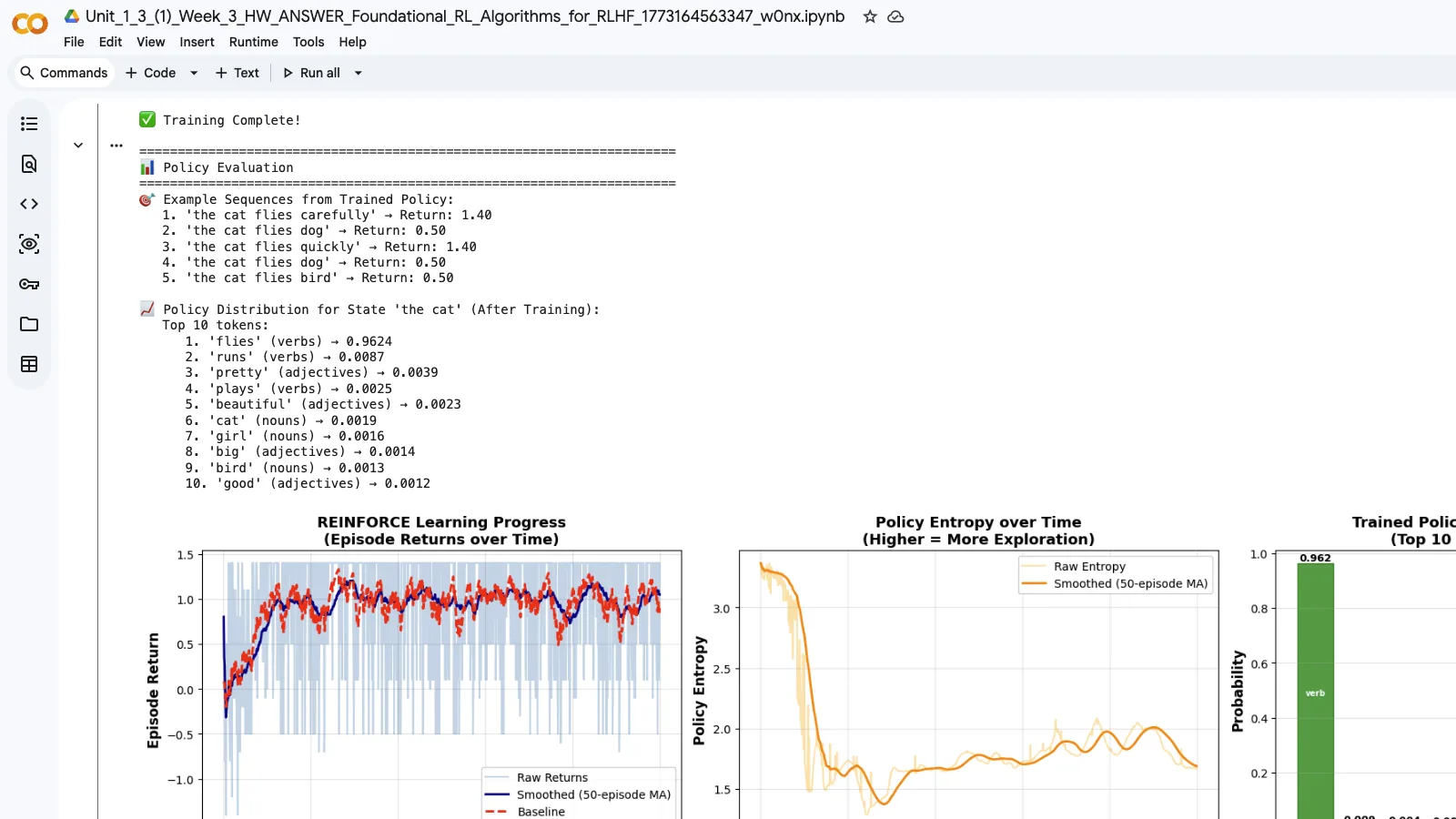
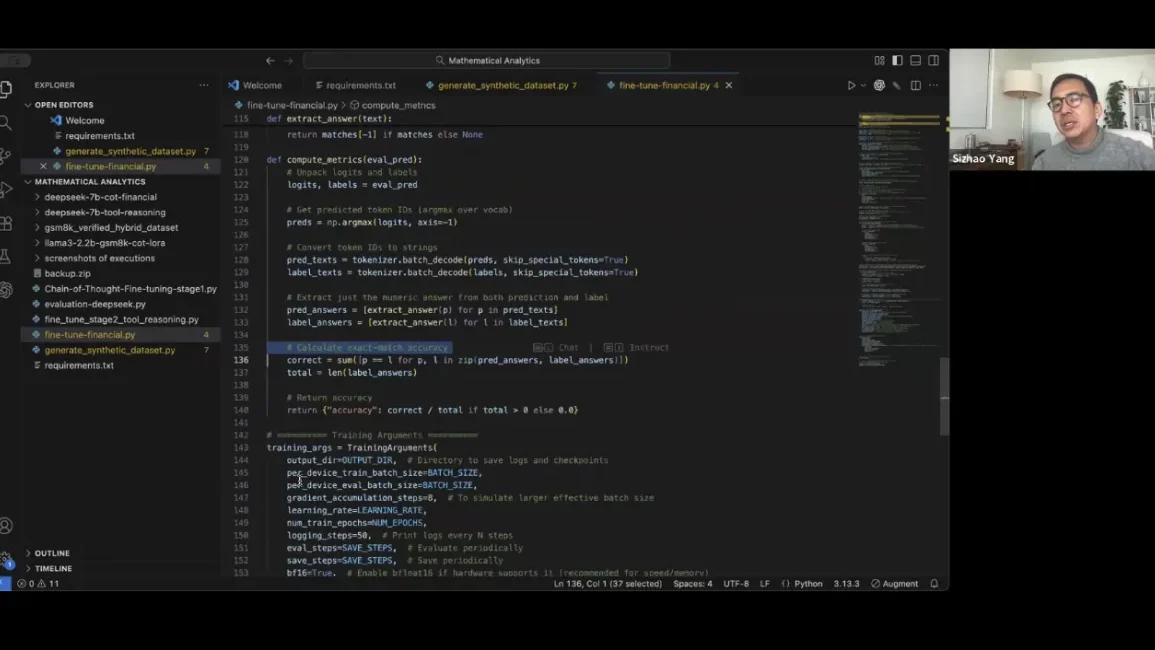
There are eight required production builds and an optional ninth. Each ships with a goal statement, an architecture diagram, evaluations with metrics, an iteration log, a README a reviewer can run, and a 90 to 180 second demo. A senior engineer reviews every one in live coaching before it counts.
"Everybody would give you a to-do app: use PyTorch, use a bunch of LLMs and stuff."
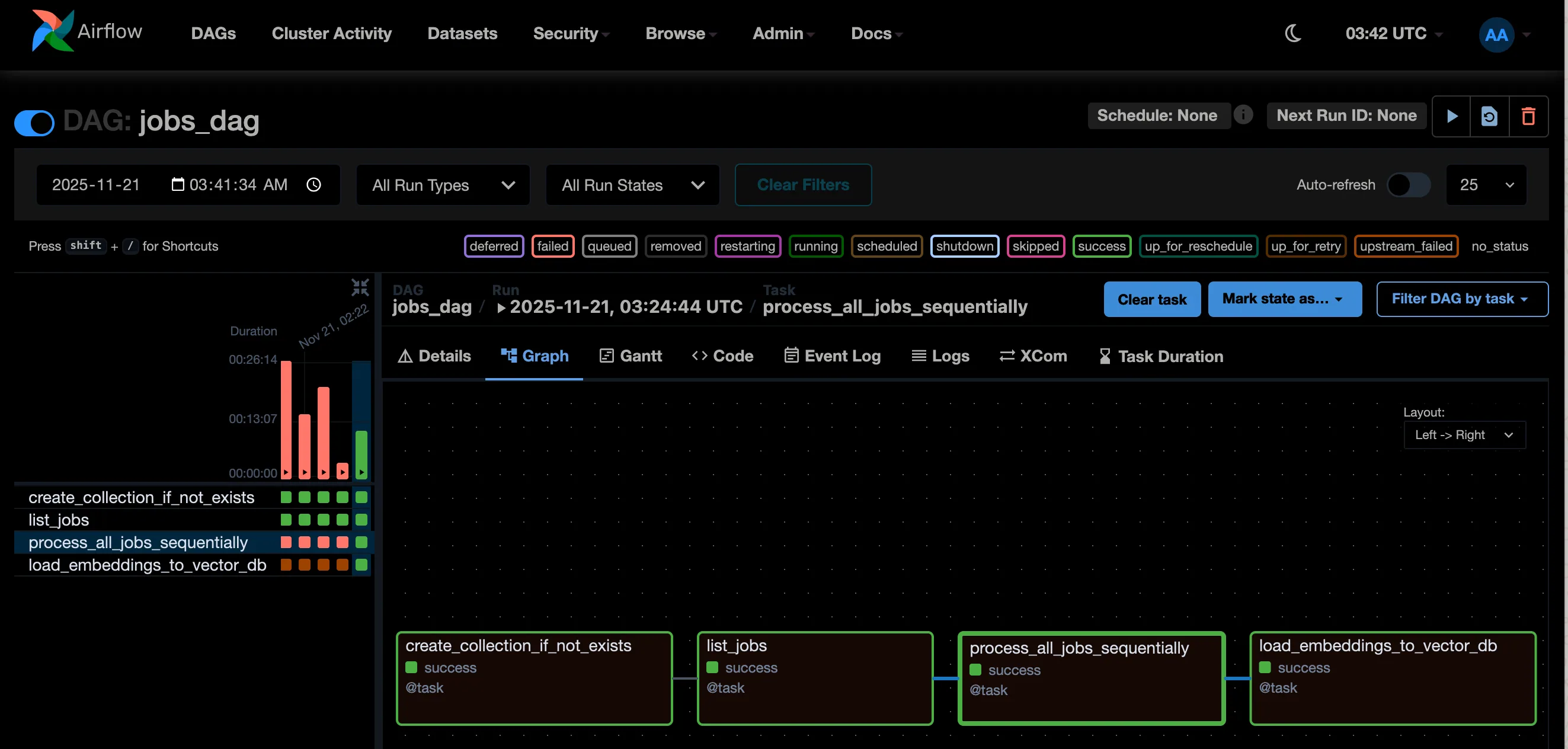
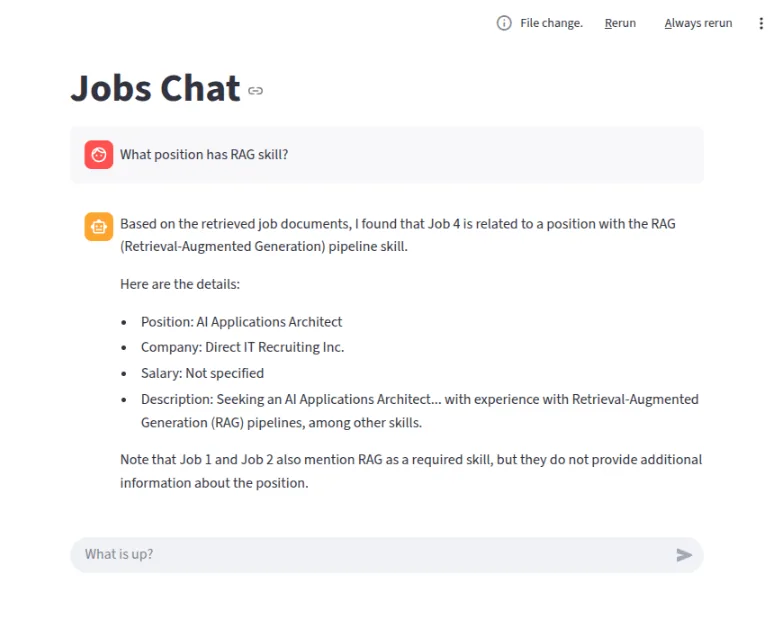
A browser extension captures LinkedIn postings, FastAPI ingests the HTML, an LLM agent extracts position, company, salary and description, embeddings land in ChromaDB, and a Streamlit chat queries the corpus with RAG. Airflow runs the pipeline on a schedule.
// the Evidence Pack you leave with
✓Repositories with clean architecture and a README a reviewer can run
✓Evaluations with metrics, and the iteration log that moved them
✓A failure analysis for each build: what broke, why, and what you changed
✓A 90 to 180 second demo video for every build
✓A one-page story per project for interviews
✓Resume, LinkedIn and developer site that point at the proof
✓At least one accepted open-source PR in an AI repository
✓Two technical blog posts in your specialization
// domain tracks
Pick one of 20 domain tracks. Your builds and blog posts focus on that domain.
Select a track to see how it changes the syllabus above.
// noteWe update unit content when a new technique reaches production. The 16-unit structure and the required builds stay fixed.
2026 is the first year we run the full placement team. Earlier cohorts were skill-focused, and most of those students were internal builders or managers rather than active job seekers. Zao and Dipen are still personally involved with every student right now. That will not be true once the program scales.
~30%~30%
About 30% of past students stay at their company.
They scope an AI project at work, build it in the program, and use it to move into an AI role there.
I was barely keeping up with some research papers before, and now I feel like I can understand even the things that are popping up every day, and lose the fear of trying any model or any technique.
Gonzalo Arreche
Co-founder · CTO · OK2Charge
“
It was something that I could do.
I thought it'd be totally overwhelming, but it really wasn't that bad.
Chris Westbrook
Software developer
“
I can develop any kind of AI applications.
I'm confident that I can develop any kind of AI applications, including AI agents or MCP servers.
Sunjith
Co-founder · Admore
// your options
Four ways into AI engineering What each costs, and what it leaves out.
Prices are 2026 figures from public sources.
01
A master's degree
time
2 years
cost
$7K to $80K+
A master's is the right choice if you want to publish research. The lower-cost programs (Georgia Tech OMSCS, UT Austin MSDS) teach theory that runs 12 to 18 months behind production, and none of them guarantee placement.
leaves out
You learn how the algorithms work. Deploying and monitoring them is rarely on the syllabus.
02
Self-teach from tutorials
time
6 to 12 months
portfolio
Not reviewed
Andrej Karpathy's course is an excellent starting point. YouTube and Udemy cover the material. However, the line we hear most often on calls is: "I have learned a ton, and I still cannot land a role."
leaves out
Nobody reviews your code, runs mock interviews with you, or sends your work to hiring managers.
03
Interview-prep bootcamps
cost
$2,400 to $12,000
pricing
On a call only
Programs like Interview Kickstart drill LeetCode for generalist roles and only publish pricing on a sales call. AI engineering interviews are project-based.
leaves out
You practice interviews but have no AI projects to talk about in them.
04
The Accelerator
time
13 weeks
cost
$8,900
You get a 1:1 roadmap, eight builds reviewed by a senior engineer, a placement team, and a conditional tuition-back guarantee. We only admit engineers who already ship code.
your 13 weeks
Roadmapwk 1
Portfoliowk 2 to 8
Outreachwk 9 to 13
“
Things that I have been taught here were never taught at my school, and specifically in my master's program I didn't find those topics.
Kevin Martell
ML master's graduate
“
You look up YouTube and there's hundreds of contents there and you don't know where to start. I was very intimidated.
Jasmine
SaaS founder
“
I took another program I won't mention. It was more of an academic setting. It was a good program, but it didn't go into depth.
Jeff O'Connell
Senior engineer
“
I knew AI was the future. I wanted to get in on it. That's why I decided to do the boot camp, and it's turned out really well.
Chris Westbrook
Software developer
Your search now
200+ applications and no replies
"We went with someone who had more ML experience."
Toy chatbots you cannot point a hiring manager at
No feedback on whether your projects meet a hiring bar
Nodding along while your team talks about AI
After the Accelerator
An outreach specialist contacting hiring managers for you
Eight builds with evals, READMEs and demo videos
Three internal interviews passed before the first real one
A negotiation plan for base, bonus, equity and sign-on
Tuition back if you meet the requirements and get no offer in 6 months
// objections
Ten objections from this year's strategy calls In the order they come up.
Some of them are partly true, and the answers say which part.
01
"$8,900 is a lot of money."
It is. Separate the two questions first: is it cash flow, or something about the program? Cash flow has two answers: one-time pay in full or three monthly payments, with financing options available. For the program question, here is the math. The average US AI engineer earns about $206,000 against a $134,000 software engineer average, so at that delta tuition is about six and a half weeks of the raise. There is no income share and no pay-after-placement. If the only way you can do this is to pay after you are hired, this is not the right program.
02
"I work full time. I do not have 8 to 10 hours a week."
It is about an hour on weekdays plus two protected blocks on the weekend, and everything live is recorded. Most of the time engineers lose to AI is spent deciding what to learn next, evaluating another framework, or restarting a path they abandoned. The Phase 1 roadmap cuts that time by skipping units you already know.
"It was definitely a lot, don't get me wrong, but it was also manageable if you can just follow the path of the course."
"I do not have a PhD, an ML background, or the math."
You are describing a horizontal AI engineer, roughly 5,000 jobs globally. We train vertical AI engineers, where the requirement is strong software engineering plus AI skills and there are about 1.6 million open roles. The program is code-first. You will need matrix multiplication and three or four other concepts, and we teach them at the moment you need them.
"I've been trying to jump on the Gen AI bandwagon since the revolution started, but I had limited knowledge in Python and machine learning."
2026 is the first year with the full placement team, so we do not quote a placement rate. What we can show you is the process: an Evidence Pack hiring managers can open, three internal interviews before your first real one, a team running outreach and applications for you, and a tuition-back guarantee if you do the work and it does not land.
05
"I already know how to code. Will I learn anything?"
In the program you build a five-agent system around a real business goal, set up production evaluation and monitoring, and trace a failing retrieval pipeline to its root cause. Your engineering experience is the part we do not have to teach. We add the AI work on top of it.
06
"Can I just do Karpathy's course and YouTube for free?"
Yes, and the material is good. What free material lacks is an order to learn it in, feedback on your work, and a way to get that work in front of employers. A video cannot review your pull request, run three interviews with you, or send your portfolio to a hiring manager.
07
"My Python is rusty. I mostly write Java, C#, or Go."
Python is the shared language we teach in because it is the industry standard. Most engineers pick up the syntax in the first two weeks. If you have never used it and do not want to learn it, this is not the right fit.
08
"I am 45. Is this realistic at my age?"
The cohort skews senior, usually 15 to 25 years of experience. The engineers you compete with for AI roles mostly transitioned recently, so nobody has ten years of production AI. Your domain experience helps, because you know what the system needs to do before you build it.
"It's an incredible journey for me being later in my career, where I've been away from engineering for a long time."
Most AI bootcamps teach basic AI programming and API wrappers. We teach full model adaptation: retrieval optimization, fine-tuning with LoRA and DPO, multi-agent systems, and evaluation. Ask any program three questions. Is there an active placement team, or only career coaching? Do they teach evaluation-centric production AI, or chat demos? Can the instructors show you production systems they built?
"I feel like it's more than a boot camp. It's more like an accelerator."
You do not need to explain a gap. Your GitHub carries production builds with evaluations, an accepted open-source PR, and technical writing in your specialization. The resume points at the proof, and the interviews are project-based rather than LeetCode.
// who should not apply
This is not for you if
✗You are not writing and shipping code professionally today
✗You have less than two years of engineering experience
✗You have never used Python and do not want to learn it
✗You need to pay after you are hired. There is no income share
✗You want to dabble in AI rather than change what you do for a living
Two instructors. One publishes AI research. One ships AI products.
Dipen has published 16 research papers and has reviewed 100+ for journals. Zao runs newline and ships its AI products.
Dr. Dipen Bhuva
PhD · LLMs and cybersecurity
✓PhD from Cleveland State University, focused on LLMs in cybersecurity.
✓200+ citations across 16 published research papers.
✓Three tier-1 publications in Elsevier journals and IEEE Access.
✓Research collaborations with NASA Glenn, the Cleveland Clinic, and the U.S. Department of Energy.
✓Official reviewer for 100+ papers across top journals.
✓Runs the group coaching calls and Q&A, reviews your builds and GitHub, and conducts your three internal interviews.
Zao Yang
Founder of newline · co-creator of FarmVille
✓Has built software products for 15+ years.
✓Co-created FarmVille, which reached 200 million users.
✓Founded Kaspa, which reached about $3B in market cap.
✓Founded or invested in 130+ companies across gaming, crypto and AI.
✓Runs newline, which has trained 250,000+ developers, including engineers at Adobe, Amazon, Salesforce and Disney.
✓Has built AI products since 2017. newline runs AI agents on its own codebase around the clock to review every pull request and apply the fixes, and the program teaches the same patterns.
“
Why Zao built the program
I started learning deep learning in 2016 and 2017 from tutorials, online courses and textbooks. I would get stuck on one error for two, three, four weeks because I had nobody to ask. Almost nothing was end to end.
The engineers who call us now describe the same thing with better tools. They have learned a lot. They still cannot land the role, because they have nothing a hiring manager can review.
So we built the program I wanted back then: a roadmap that starts from what you already know, production builds reviewed by engineers who ship AI systems, and a placement team that sends your work to hiring managers. We use everything we teach on our own codebase every day.
Zao Yang, founder, newline
// three outcomes
Three ways students use the program A new job, a promotion, or their own product.
Most students enroll to change jobs. About 30% stay at their company and move into an AI role there. Others build a product or practice of their own.
Most engineers start here
A new AI engineering role
Move into an AI Engineer, Applied AI or AI Platform role at a product company. You get the roadmap, the Evidence Pack, and the placement team until you have an offer.
✓AI Engineer, Applied AI, AI Platform, AI Lead
✓Placement team on outreach and applications
✓Conditional tuition-back guarantee
~30% take this path
Internal promotion
Stay at your company and move into an AI role there. You scope an AI project at work, build it in the program with senior review, and bring the results to your manager. In several cases, the company paid part or all of tuition.
✓An AI title at your current company, no job search
✓Scoped internal AI project
✓Employer reimbursement pitch deck included
Founders and operators
Your own AI product or practice
Ship an AI product solo or with a small team, or build internal systems that replace SaaS tools. The curriculum is the same, and your builds are chosen around your product.
✓Domain track built around your product
✓Evaluation results you can show clients
✓The path Michael, Jasmine and Gonzalo took
“
I don't think I could have had those conversations without going through the course and doing the work.
Anup
Full-stack and data engineer
“
Now I'm confident that I can use this knowledge that I have learned in boot camp in the real life projects that I need to drive in the corporate world.
Ruby
Principal engineer · manager
“
I decided to build a product that came to my mind after going through the program.
Jasmine
SaaS founder and engineer
// employer reimbursementAbout 30% of past students had their company pay for part or all of the program because they were delivering an internal AI project while learning. You get a reimbursement pitch deck and template to give your manager, and a $500 refundable deposit holds your seat while you ask.
// pricing
Tuition against the salary difference At the average salary difference, one year of AI engineering pay covers tuition about 7 times.
Average US AI engineer salary
$206,000$206,000
Glassdoor analysis of 1,000 postings, 2025
Average US software engineer salary
$134,145$134,145
Glassdoor, 2025
Difference, per year
+$72,000+$72,000
Before negotiation
At that difference, the raise covers tuition in about 6.5 weeks, before taxes.
Pick a track to see what its tuition covers.
learn
A 16-unit curriculum
cut down to your path
Your roadmap is set on the week-one call
20 to 30 hours of lessons, aimed at what you are missing
Live sessions every week, all recorded
you skip what you already know
16 units plus Bootcamp 2
three advanced units, 25 lessons
The full Accelerator curriculum, plus:
State-of-the-art agents with advanced and multimodal RAG
Advanced AI evals and monitoring
Reinforcement learning and RLHF, from the basics to frameworks
where RAG, fine-tuning and RLHF fit in production
A research-track curriculum
on top of Bootcamp 2
The full Consultant curriculum, plus:
Transformer internals and fine-tuning, at depth
RLHF and evaluations, at depth
mentored 1:1 by a published AI researcher
build
Eight production builds
each reviewed by a senior engineer
Every build carries evaluations, metrics and a failure analysis
Each ships with a README and a 90 to 180 second demo
A reviewer can clone it, run it and see the numbers
Plus an accepted open-source PR and technical writing
all of it on your own GitHub
A production-grade capstone
a RAG and fine-tuned LLM service
All eight Accelerator builds, plus:
Tool routing, multimodal retrieval and function calling
An LLM-as-judge pipeline and monitoring, aimed at 95% end-to-end task accuracy
A small LLM fine-tuned with LoRA, then RLHF, compared against its base
all of it on your own GitHub
A custom research project
shipped to a public benchmark
Every Consultant build, plus:
A co-author opportunity on an open-source paper or artifact
Evaluations, metrics and a failure analysis, like every build
results anyone can check
get placed
A placement team
that stays through the offer
Outreach and applications run on your behalf, every week
A resume, GitHub and portfolio a hiring manager can assess
Mock rounds with subject-matter experts
Negotiation coaching on base, bonus, equity and sign-on
backed by the tuition-back guarantee
A placement team
aimed at senior roles
The same placement team, through the offer
Outreach and applications aimed at senior AI engineer roles
Or a portfolio positioned for client work, if you run your own practice
Negotiation coaching on base, bonus, equity and sign-on
backed by the tuition-back guarantee
Targeted placement
into applied and research engineer roles
The Accelerator placement team, plus:
Outreach aimed at Applied and Research Engineer roles
An extended placement window
Aimed at $200K to $400K+ offers
backed by the tuition-back guarantee
// hold a seatA $500 refundable deposit holds your seat while you sort out financing or employer approval.
// policyWe offer payment plans. We do not offer discounts, income share or pay-after-placement.
// the three tracks
All three tracks share the core curriculum and the placement team, and each includes everything in the one before it. The consultant track adds Bootcamp 2: advanced agents, evals and RLHF. The researcher track adds research work and targets applied research roles. Not sure which fits? We recommend one on a free career strategy call.
Most engineers start here
AI Engineering Accelerator
For software engineers becoming AI engineers.
save $1,000
$8,900one-time
Paid in full at enrollment
✓Units 1 to 17: the core curriculum and all recordings
✓90-day Bridge System (4 phases)
✓8 production-grade portfolio projects
✓Senior engineer mentorship + code review
✓Done-for-you outbound to hiring managers
✓Mock interviews + offer negotiation
✓Internal-promotion track included
✓100% tuition back if no role in 6 months
target outcome
$140K to $250K+ AI engineer offer
// pick this ifyou want to ship AI features at a product company.














































 Cohere Rerank
 Sentence Transformers
 ColBERT
 ColQwen-Omni
 BERTopic
 Logfire
 DSPy
DSPy OpenPipe ART
 PufferLib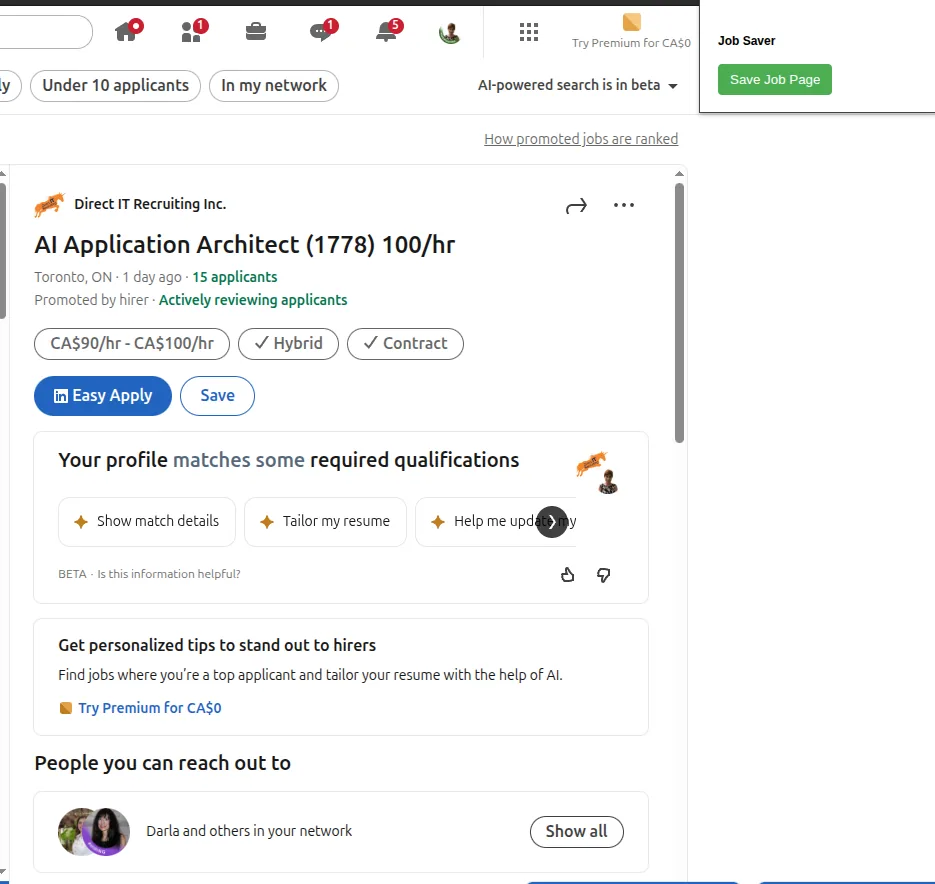

'%3e%3cpath%20fill-rule='evenodd'%20clip-rule='evenodd'%20d='M2.02533%2074.2306L5.54738%2045.8325L153.595%20302.881L138.666%20311.521L2.02533%2074.2306Z'%20fill='%23FA5252'/%3e%3cpath%20fill-rule='evenodd'%20clip-rule='evenodd'%20d='M4.99011%2046.175L19.9187%2037.5351L167.966%20294.583L153.038%20303.223L4.99011%2046.175Z'%20fill='%23BE4BDB'/%3e%3cpath%20fill-rule='evenodd'%20clip-rule='evenodd'%20d='M19.3615%2037.8777L34.2901%2029.2377L182.338%20286.286L167.409%20294.926L19.3615%2037.8777Z'%20fill='%234C6EF5'/%3e%3cpath%20fill-rule='evenodd'%20clip-rule='evenodd'%20d='M33.7328%2029.5806L48.6614%2020.9406L196.709%20277.989L181.78%20286.629L33.7328%2029.5806Z'%20fill='%2340C057'/%3e%3cpath%20fill-rule='evenodd'%20clip-rule='evenodd'%20d='M48.1042%2021.2832L63.0328%2012.6432L211.08%20269.691L196.152%20278.331L48.1042%2021.2832Z'%20fill='%23FAB005'/%3e%3cpath%20fill-rule='evenodd'%20clip-rule='evenodd'%20d='M62.4756%2012.9858L77.4042%204.34589L225.452%20261.394L210.523%20270.034L62.4756%2012.9858Z'%20fill='%23FD7E14'/%3e%3cpath%20fill-rule='evenodd'%20clip-rule='evenodd'%20d='M12.5896%201.30957H63.8718C71.9836%201.30957%2079.7267%205.1638%2079.7267%2013.257V65.5802C79.7267%2073.6725%2073.1517%2080.2326%2065.039%2080.2326H12.5896C4.95189%2080.2326%201.61738%2075.474%200.909873%2068.0388C0.202366%2060.6036%20-2.09808%2066.0532%20-2.09808%2065.5802L0.909873%2015.8941C0.909873%207.80188%204.47689%201.30957%2012.5896%201.30957Z'%20fill='white'/%3e%3cpath%20fill-rule='evenodd'%20clip-rule='evenodd'%20d='M67.1371%200H14.6877C6.57497%200%200%206.56007%200%2014.6523V66.9756C0%2075.0688%206.57589%2081.6279%2014.6877%2081.6279H67.1371C75.2498%2081.6279%2081.8248%2075.0678%2081.8248%2066.9756V14.6523C81.8248%206.55915%2075.2489%200%2067.1371%200ZM14.6877%2077.4419C8.893%2077.4419%204.19614%2072.7565%204.19614%2066.9756V14.6523C4.19614%208.8716%208.8928%204.18605%2014.6877%204.18605H67.1371C72.9318%204.18605%2077.6286%208.8714%2077.6286%2014.6523V66.9756C77.6286%2072.7563%2072.932%2077.4419%2067.1371%2077.4419H14.6877Z'%20fill='%2327394B'/%3e%3cpath%20fill-rule='evenodd'%20clip-rule='evenodd'%20d='M19.3265%2018.8457L12.8355%2021.5612L36.601%2067.8289L43.4584%2065.7923L19.3265%2018.8457ZM54.8998%2037.0708C57.046%2037.0708%2058.4594%2038.2719%2058.4594%2042.5018V57.907H65.8926V39.8385C65.8926%2033.4153%2063.0659%2030.7521%2058.564%2030.7521C55.0045%2030.7521%2052.4395%2032.3709%2050.4503%2034.2509L50.0839%2031.3265L43.1741%2031.6921C43.5405%2037.593%2043.6452%2045.6873%2043.6452%2057.907H51.0784C51.0784%2050.0738%2050.9738%2043.3373%2050.8691%2038.3241C52.073%2037.5408%2053.3817%2037.0708%2054.8998%2037.0708Z'%20fill='%2327394B'/%3e%3c/g%3e%3c/svg%3e)